
In partnership with


Gen Z is the first generation less cognitively capable than their parents but Denmark has a solution
"Since the late 1800s, every generation has outperformed their parents."
Nearly every parent hopes their child will be better off than they are: smarter, more secure, and more well-adjusted. Many parents see this as a stamp of successful parenting, but something has changed for children growing up today. While younger generations are known for their empathy, their cognitive capabilities seem to be lagging behind those of previous generations for the first time in history.
Dr. Jared Cooney Horvath, a teacher turned cognitive neuroscientist who focuses on human learning, appeared before Congress to discuss concerns about cognitive development in children. In his address to the members of Congress, he says, "A sad fact that our generation has to face is this: our kids are less cognitively capable than we were at their age. Since we've been standardizing and measuring cognitive development since the late 1800s, every generation has outperformed their parents, and that's exactly what we want. We want sharper kids."
Write while you hold the baby

You should not have to wait for quiet to get things done. Wispr Flow turns your spoken thoughts into final-draft writing so you can reply to messages, draft a school email, or update a freelance brief while caring for your family. It removes filler, corrects punctuation, formats lists, and keeps your tone so sending is one step. Works on Mac, Windows, and iPhone. Try Wispr Flow for parents.

"Are younger folks going to come in and put on some raves?"
The time has come. Some Gen X-ers have officially begun to enter their "third act," in which they're picking out and moving into senior living facilities. (Though to be fair, the oldest Gen X-er in 2026 is only 61, so still relatively young.) But as each generation enters this season of life, surely the senior homes will reflect their generational preferences.
A thread on Reddit got right to the meat of it, posting this question: "How do you envision what Gen X nursing homes will be like?" They follow this up with a few thoughts, "The most striking difference between visiting my great grandparents, grandparents, and parents in a nursing home was the musical entertainment. It used to be old wartime songs and now it's the Beatles and Rolling Stones tunes.
Are younger folks going to come in and put on some raves? Will a band play Alice in Chains and Pearl Jam songs? Will a DJ start a dance party for us with us chiming, 'It's Britney, Bitch?' My dream nursing home would be a converted abandoned mall and revive it as a hangout place: arcades, Dairy Queen, movie theater, shops."
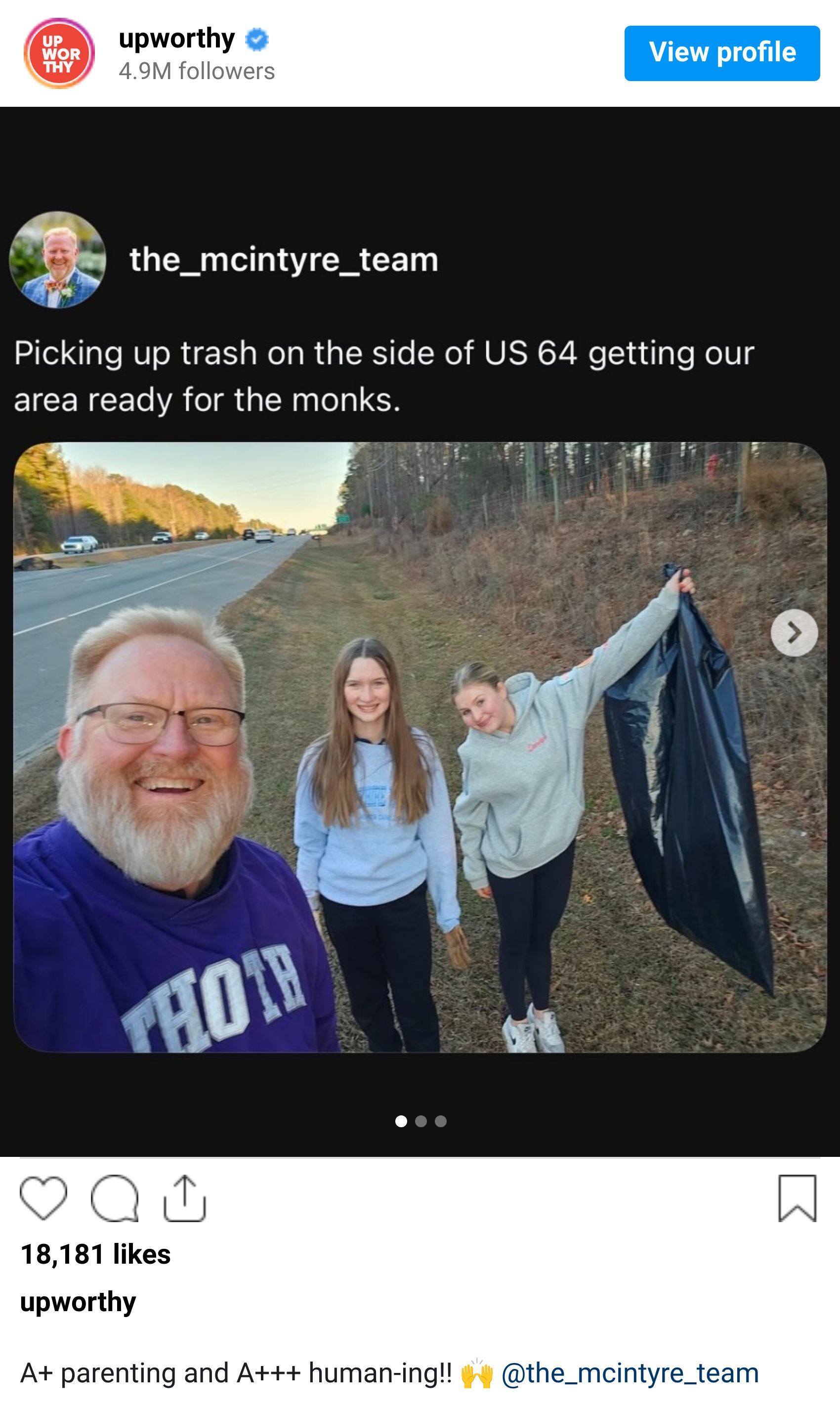
A+ parenting and A+++ human-ing!! 🙌

Forty years ago, restoration workers thought logs were the problem. They were wrong.
By Heather Wake
For decades, river restoration in the Northwestern United States followed a simple rule: if you saw logs in the water, take them out. Clean streams were seen as healthy streams, fast-moving water was seen as optimal, and wood was treated like a "barrier" to natural processes, particularly those of the local fish.
Now, helicopters are flying thousands of tree trunks back into rivers to undo that thinking.
In central Washington, one of the largest river restoration efforts ever attempted in the region is underway. More than 6,000 logs are being placed along roughly 38 kilometers, or 24 miles, of rivers and streams across the Yakama Reservation and surrounding ceded lands.
Nearly 40 years ago, Scott Nicolai was doing the opposite kind of work, all in the name of restoration.

This is why lifelong learning matters.
By Annie Reneau
If you were born in the 20th century, you were undoubtedly taught that our solar system consisted of the Sun orbited by nine planets. The planet farthest from the Sun was also the smallest: Pluto. In 2006, that fact changed. Pluto was demoted from full planet to dwarf planet, and the solar system now consists of the Sun and eight planets. What we were taught was correct based on the knowledge at the time, but it's now incorrect to say there are nine planets in our solar system.
There's nothing wrong with this, of course. As study and research advance our understanding of the world, facts sometimes change. There was a time when doctors recommended smoking, and now we know differently. Maps of the world have changed throughout history as our knowledge of geography has expanded. So people who went to school decades ago naturally learned some things that we now know to be incorrect.
