
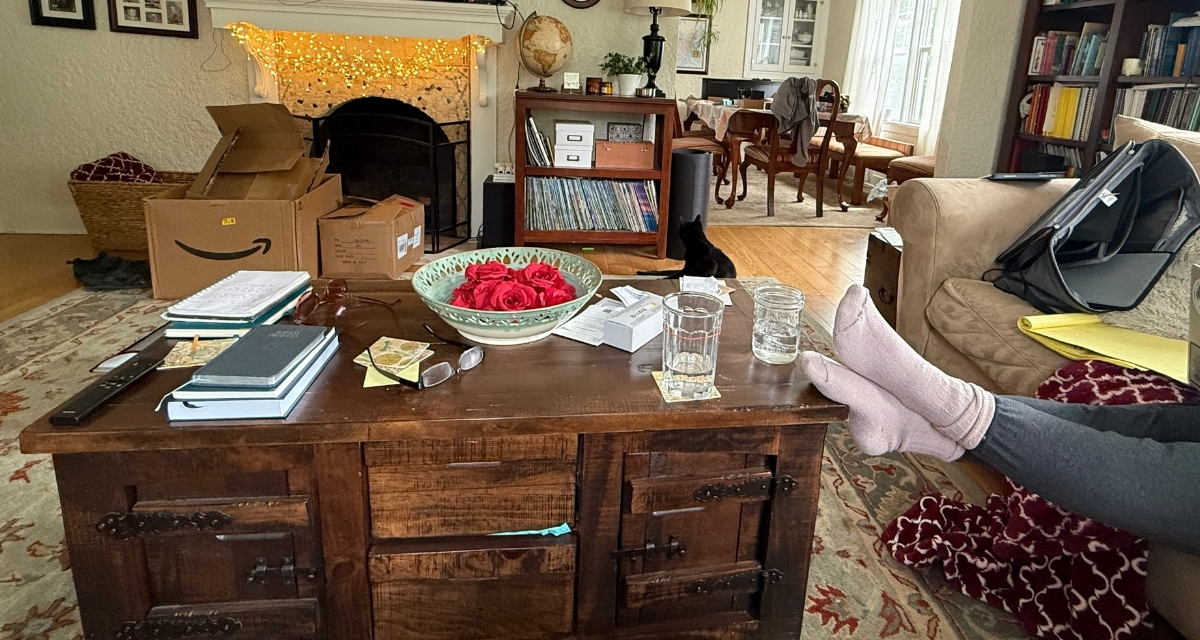
Let's just say our house has a "lived in" vibe.
The liberating ‘realness’ of normal house mess in an age of curated perfection
I’ve gotten the same response from guests over and over.
By Annie Reneau
For most of my life, I’ve longed to live in an immaculate home. I watched aspirational house content with wistful envy, wondering if it’s really possible to keep your house perfectly tidy at all times.
I’ve known people who live in a state of near-perpetual neatness. I am not one of them. Though it’s taken me decades, I’ve now accepted the fact that my home is at least somewhat messy more often than not.
| Read the story |

9 things I’ve learned about people after hosting over 1,000 strangers in my home
People will surprise you.
By Annie Reneau
In 2016, my husband and I listed the mother-in-law apartment in our basement on Airbnb. Since then, we’ve moved into the house next door, turned the upstairs of the old house into another short-term rental apartment, and hosted over 1,000 guests.
We love welcoming people into our home, and we’ve learned a lot from hosting over the years. While there’s only so much one can extrapolate about humanity from having a short-term rental, there’s also a lot we’ve learned about people that has surprised us.
| Read the story |
Shoutout to all the Coach B’s in the world 🥹


Celebrate National Smile Day with Upworthy and Operation Smile at the Bubble Pop Up at Westfield Century City's Kid's Play Space on Sunday, May 31st!
What do bubbles and smiles have in common? For kids born with cleft lip and palate, blowing bubbles can be part of comprehensive care, helping to strengthen facial muscles and improve breath control.
Through Operation Smile, children with cleft conditions receive free surgery and ongoing care that transforms their lives. Pop bubbles and learn more about the incredible work Operation Smile provides for kids around the world.
Thank you to our friends at Sterling Engagements and Westfield Century City for making this possible!

A group of coworkers celebrates.
New study shows how a four-day work week gets more done in less time
Your terminal “case of the Mondays” may have a cure.
The traditional 40-hour work week made the most sense during the manufacturing-heavy early 20th century, but it feels awfully outdated in today’s digital and service-driven economy. Older generations seemed to accept burnout, chronic stress, and a fractured work-life balance as the “cost of doing business.” Some still often brag proudly about it—but is the Monday-through-Friday grind something we all have to accept?
The folks in the “Land Down Under” say nope. A new study conducted among 15 Australian companies that instituted a four-day working week is challenging the commonly accepted status quo. Published in Nature’s Humanities and Social Sciences Communications, the research tracked a variety of firms as they adopted the “100:80:100” model at their places of business: employees receive 100% of their pay for 80% of the time, provided they maintain 100% of their baseline productivity.
| Read the story |
