
In partnership with


Most people never regret just staying silent.
By Tod Perry
It can be hard to stay quiet when you feel like you just have to speak your mind. But sometimes it's not a great idea to share your opinions on current events with your dad or tell your boss where they're wrong in a meeting. And having a bit of self-control during a fight with your spouse is a good way to avoid apologizing the next morning.
Further, when we fight the urge to talk when it's not necessary, we become better listeners and give others a moment in the spotlight to share their views. Building that small mental muscle to respond to events rather than react can make all the difference in social situations.
Simplify Your ADHD Management with Science

Finding the right way to manage ADHD can be exhausting. Inflow changes that by combining therapy-backed strategies with an easy-to-use platform.
Access bite-sized modules, live coworking sessions, and focus rooms to keep you on track. Whether you struggle with impulsivity, anxiety, or executive function, Inflow offers practical brain hacks to help you reclaim your time.
Take the free assessment to see how you can improve focus and create lasting habits in just 5 minutes a day.

Career coach shares the best way to answer the question 'Why do you want to leave your current job?'
Always feel prepared.
By Erik Barnes
"Why do you want to leave your current job?"
This common interview question can trip up even the most qualified candidates. Should you share specifics, and if so, which ones? Would being vague raise suspicion? Could some details come off as too negative? One career coach offers a smart approach that keeps the focus on the one thing everyone is invested in: filling the vacant role.
"You should frame it as a pull instead of a push," career coach Madeline Mann said in a TikTok video.
Rather than answering the question with common replies such as wanting a different opportunity or having no room for advancement in your current role, which "push" you away from your current employer, shift the focus of your answer to the "pull" of the open position. That includes the job description, the appeal of the company, and the factors that drew you to apply or prompted a recruiter to reach out.
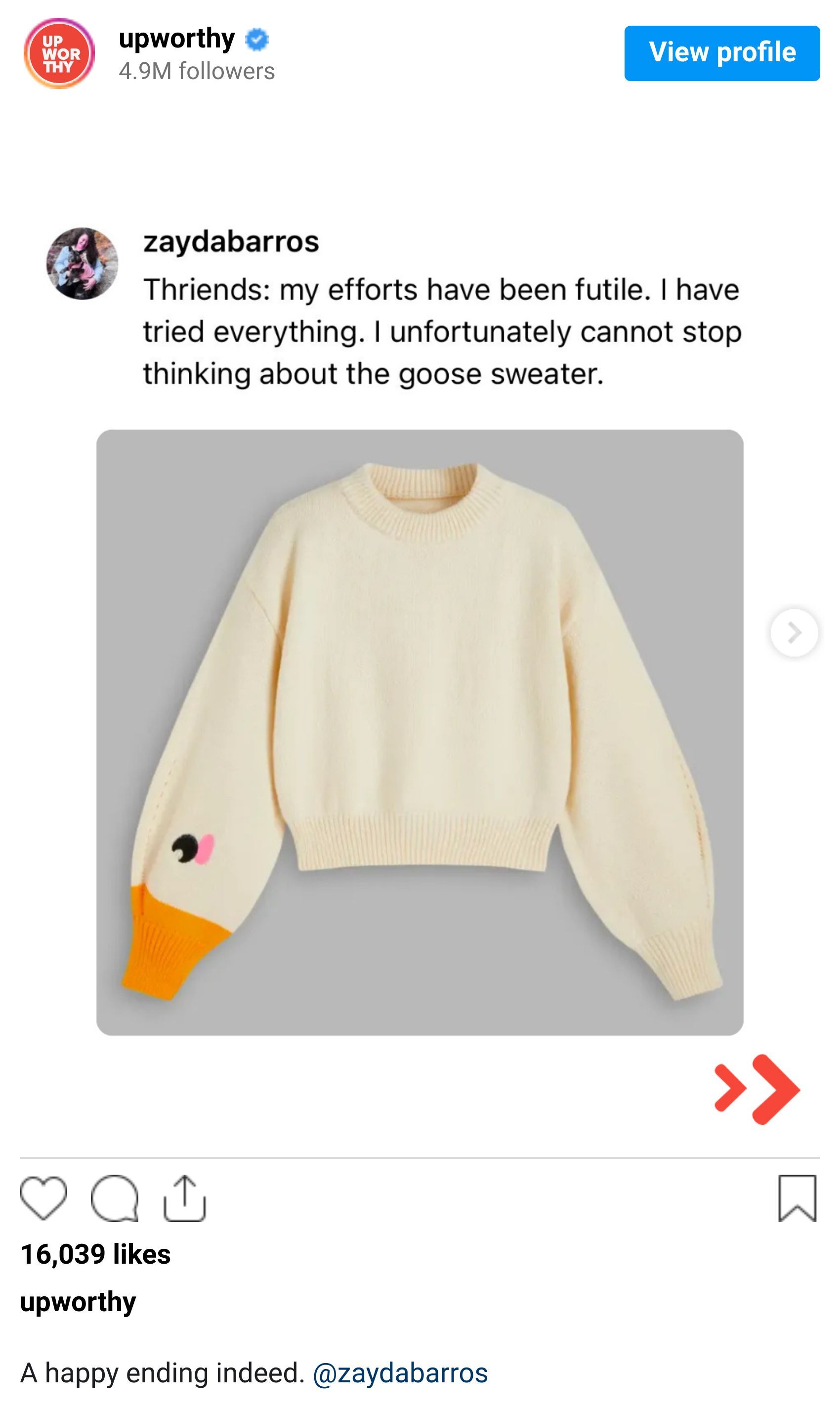
A happy ending indeed.

Give your brain a moment to encode what you're learning.
By Tod Perry
Learning a new skill means studying and then practice, practice, practice. That might mean learning how to read music and then playing “Für Elise” by Beethoven over and over again. Or, if you’re learning to speak French, you have to memorize the words and then hone your pronunciation through repetition. But what would happen if you gave your brain a moment during practice to really soak in what it was doing instead of a nonstop information dump?
A 2021 study from the National Institutes of Health found that when you’re studying a new skill and practicing, you can speed up your progress by taking short breaks. Instead of keeping your head in the piano and playing for 45 minutes straight, your brain does a better job at encoding new information if you drop in a series of 10-second breaks.

The most hilariously dramatic apology ever.
By Annie Reneau
In ball sports, it's common for an errant ball to hit a target an athlete didn't mean to hit. If that unintended target happens to be a person, the athlete will usually apologize for the accident. And if that athlete is Japanese volleyball player Yuji Nishida, the apology will be one for the ages.
Nishida was serving in an all-star volleyball tournament in Kobe, Japan, when his serve went awry and hit a courtside judge in the back, according to The Guardian. Before the judge even had time to react, Nishida sprinted across the court, dove under the net, and slid headfirst on his belly to her feet. He remained outstretched on the court, his forehead and nose pressed to the floor, before standing up and bowing deeply and repeatedly to the smiling judge. She laughed and bowed in return, letting him know it was all good.
