
In partnership with


Tommy Tutone’s frontman said he hopes it makes people smile.
By Erik Barnes
Since the 1980s, one particular phone number has earwormed its way into pop culture’s collective memory. That number? 867-5309 (which you probably just sang in your head). Today, however, that memorable number doesn’t belong to Jenny anymore. Thanks to Tommy Tutone’s frontman, dialing it now connects cancer patients to a support group.
Tommy Heath, the lead singer of Tommy Tutone, teamed up with the Cancer Support Community to secure the number for its free support helpline. In an exclusive interview with People, Heath shared how cancer has affected him as he’s gotten older, noting that he is dealing with “minor” skin cancer himself.
Every headline satisfies an opinion. Except ours.

Remember when the news was about what happened, not how to feel about it? 1440's Daily Digest is bringing that back. Every morning, they sift through 100+ sources to deliver a concise, unbiased briefing — no pundits, no paywalls, no politics. Just the facts, all in five minutes. For free.

Audiences are already begging for him to do it again.
By Heather Wake
Saturday Night Live UK debuted over the weekend on Sky TV (and Peacock in America), and already, one performer is a fan favorite. In a skit titled “David Attenborough’s Last Supper,” the famed naturalist, played by George Fouracres, invites several of “history’s greatest Britons,” who have been resurrected thanks to his brother Richard Attenborough’s “Jurassic Park technology.”
Naturally, the sketch featured a slew of impressive celebrity impersonations, from Freddie Mercury to Winston Churchill to Agatha Christie. But even in a sea of notable performances, it was comedian Jack Shep’s Princess Diana who really stole the show.
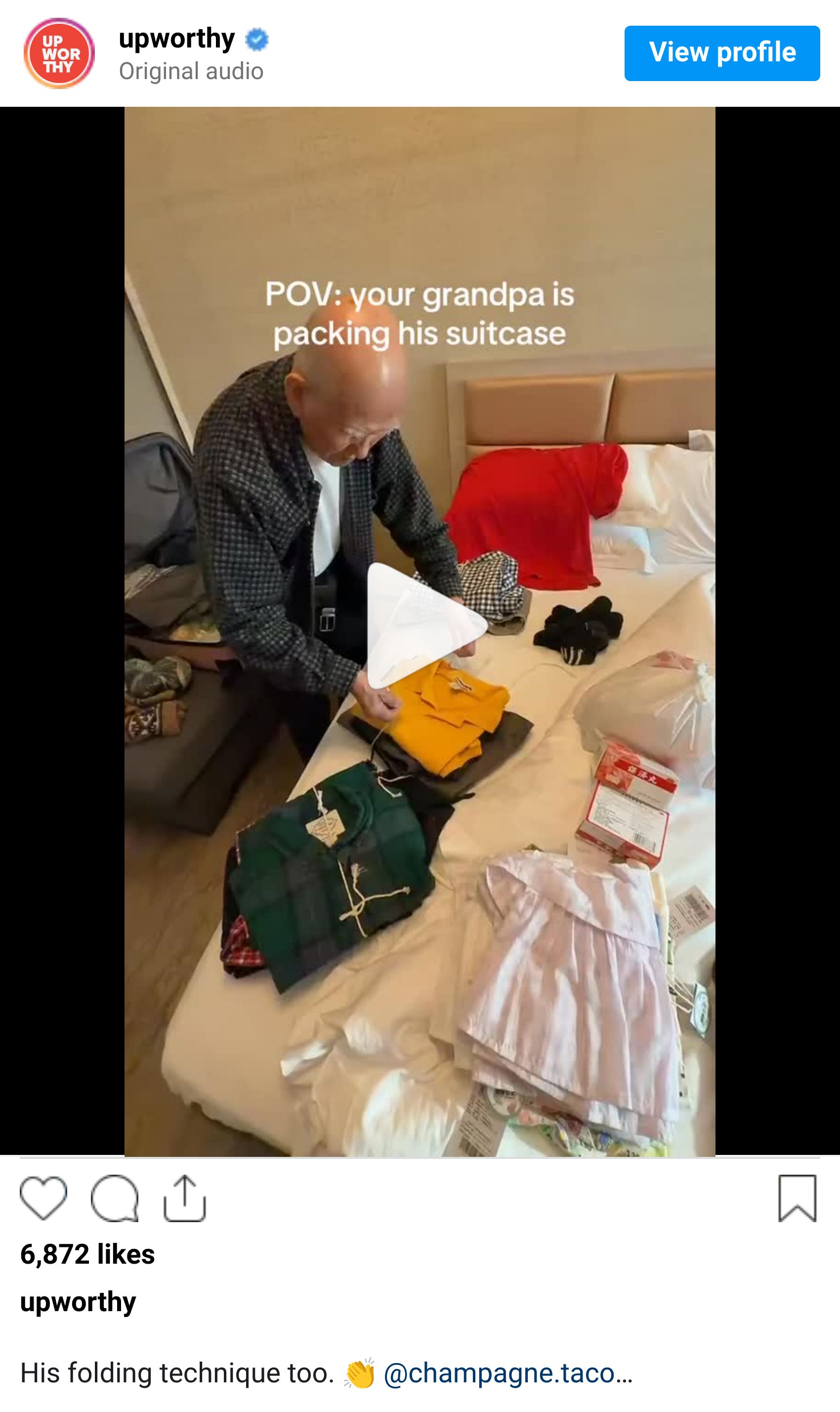
His folding technique too. 👏

Counterintuitive in our culture, but effective.
By Annie Reneau
We live in a society that prizes ambition, celebrating goal-setting, and hustle culture as praiseworthy vehicles on the road to success. We also live in a society that associates successfully getting whatever our hearts desire with happiness. The formula we internalize from an early age is that desire + ambition + goal-setting + doing what it takes = a successful, happy life.
But as Harvard University happiness researcher Arthur C. Brooks has found, in his studies as well as his own experience, that happiness doesn't follow that formula. "It took me too long to figure this one out," Brooks told podcast host Tim Ferris, explaining why he uses a "reverse bucket list" to live a happier life.

Entrepreneur and author Mo Gawdat has spent over 20 years researching the science of happiness.
By kat hong
We've all been there: it's 90 degrees outside, absolutely sweltering, and you're walking home from a new smoothie shop less than a mile away from your apartment, and everything is melting. The smoothie in your right hand. The açaí bowl in your left. Your old, broken headphones slowly slip off your head as a song you've never heard before blares through the speakers. Your willpower is diminishing by the second, and no one is around to help you.
Okay, that might be a bit specific (and precisely what happened to me about an hour ago). Still, you've likely had a similar experience: an encounter that left you annoyed, frustrated, or feeling hopeless.
But what if I told you that, according to Mo Gawat—a former Google executive who has spent the last 20 years researching the mechanics of happiness—you only need to endure that emotional roller coaster for precisely 90 seconds?
